Statistical Practice in Epidemiology using
R.
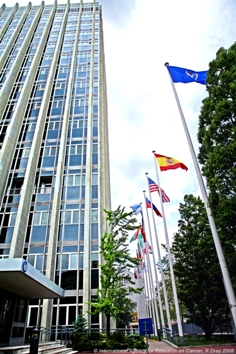
Course from Monday 5 to Friday 9 September 2011 Lyon, France
Organized by the International Agency
for Research on Cancer. Previous courses were given in 2002, 2004, 2005, 2006, 2007, 2008 and 2010 in
Tartu, Estonia.
Audience
The course is intended for epidemiologists and statisticians who
wish
to use R for
statistical modelling and analysis of epidemiological data. The
course requires basic knowledge of epidemiological concepts and
study types. These will only be briefly reviewed, whereas the more
advanced epidemiological and statistical concepts will be treated in
depth.
Contents

- History of R. Language. Objects. Functions.
- Interface to other dataformats. Dataframes.
- Tabulation of data.
- Logistic regression for case-control-studies.
- Poisson regression for follow-up studies.
- Causal inference.
- Parametrization of models.
- Graphics in R.
- Graphical reporting of results.
- Time-splitting & Standardized Mortality Ratios.
- Survival analysis and competing risks.
- Nested and matched case-control studies.
- Case-cohort studies.
- Using Markov Chain Monte Carlo with JAGS.
All methods will be thoroughly illustrated using R in practical
exercises.
The Epi
package
which is developed for epidemiological analysis in R will be
introduced.
Particular attention will be given to the reporting of the results; in
particular the use of graphics.
Faculty:
- Bendix Carstensen,
Senior Statistician,
Steno Diabetes Center, Gentofte &
Department of Biostatistics,
University of Copenhagen, Denmark.
Maintainer of the Epi package for R
- Krista Fischer,
Senior Researcher,
Estonian Genome Center, University of Tartu, Estonia.
- Esa Läärä,
Professor of Biometry, Department of Mathematical Sciences, University
of Oulu, Finland.
- Martyn Plummer,
Statistician, International Agency for
Research on Cancer, Lyon, France.
Member of the R core team.

Course fee: 550 EUR
Includes course, course material, coffee breaks and social
events (welcome cocktail on Monday and course dinner on Thursday)
Excludes transport, accommodation, lunches and dinners.
The course is a self-supporting entity, and there are NO grants
or stipends available for travel or participation.
Application:
Deadline for application: 22 May 2011
Fill in
the application
form and return by email
to Martyn Plummer.
Information to applicants will be given by e-mail shortly after the
deadline.
Accommodation:
Students are responsible for arranging their
own accomodation. A list of hotels and residences will be sent to
successful applicants.
Transport and getting around in Lyon:
Lyon airport is an
international airport serving 120 destinations,
mainly in Europe. Some routes are available on low-cost airlines. The
course starts early morning, so arrival in Lyon must be on Sunday 4
September.
There is also a fast train
(TGV)
connection from Paris Charles de Gaulle airport to Lyon city centre. The TGV takes around 2 hours.
Lyon has an extensive public
transport network. IARC can be reached from the town centre on
metro line D.
Venue:
Directions to
IARC.
Updated 14 April 2011